
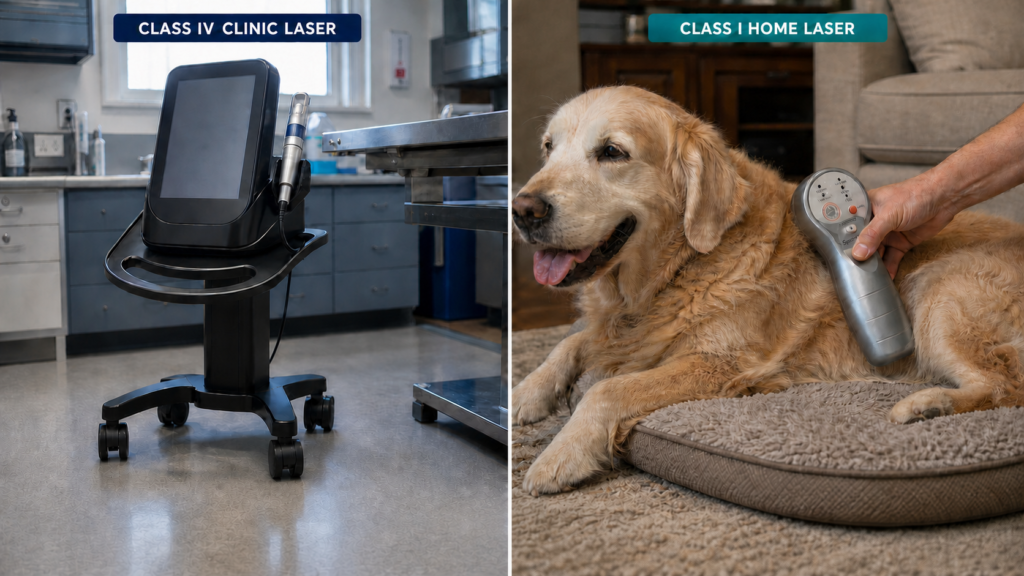
When pet parents compare a Class 4 laser with a low-level laser for dogs, many vet clinics and laser manufacturers imply that a higher class number is a better treatment option. But the class number does not tell us which laser heals better.
Laser class describes the potential hazard from the light source. It is not a rating for tissue depth, medical quality, or treatment results. A Class IV veterinary laser and a well-designed home low-level laser both produce photobiomodulation in the same way. They both use light to change activity within the cells, resulting in reduced pain, reduced inflammation, improved circulation, and stimulation of tissue repair.
I have used laser therapy in veterinary clinics and in homes for more than 14 years. For most dogs who can be treated safely at home, I prefer a high-quality low-level cold laser. The treatment takes a few minutes longer, but it is safer, easier to repeat, and much less stressful for the dog.
Class 4 Laser vs Low Level Laser for Dogs: What Is the Difference?
The main difference is how quickly and intensely the device delivers light. A Class IV laser uses high power to deliver energy rapidly. A low-level home cold laser delivers light more gently over a longer treatment period.
Both categories deliver laser therapy when the device and protocol are appropriate. The goal is to give the tissue useful light without cutting, burning, or overheating it. The device still has to provide the right wavelengths, output, treatment area, timing, and placement for the tissue we want to reach.
Both Deliver Cold Laser Therapy
Photobiomodulation is the biological response created when red or infrared light is absorbed by tissue. The light changes cell signaling and energy activity. Research has proven the beneficial effects on cellular energy, circulation, inflammatory signaling, and pain pathways when suitable treatment parameters are used.
This is why I do not consider a home laser a weak version of an in-clinic device. A suitable home device works toward the same biological goal and delivers the light more safely. A class label alone cannot predict the therapeutic results.
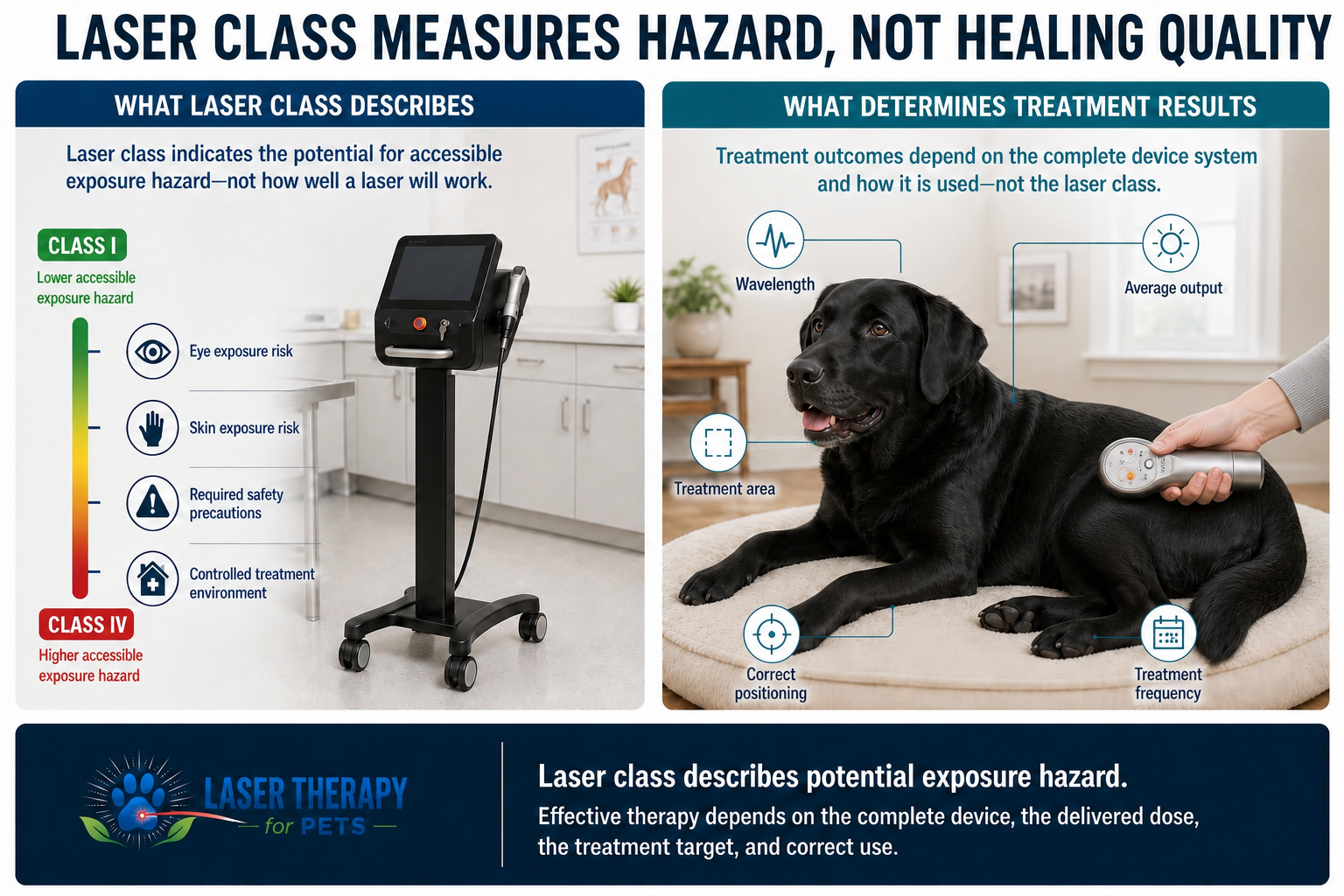
Laser Class Measures Hazard, Not Healing Quality
The FDA and international standards for laser products state that devices are classified according to their degree of optical (eye) radiation hazard. The higher the laser classification, the greater the risk of damage to you and your pet.
Laser class tells us how much potential harm the accessible light can cause. It does not tell us how well the device will treat arthritis, a ligament, a wound, or a painful back.
A Class IV therapeutic laser is not a surgical cutting laser. It is used for cold laser therapy. Its high accessible output requires stricter controls because direct exposure, reflected light, and the potential to burn your dog carries a greater risk than an in-home low-level laser device.
FDA Official Laser Classification Definitions
| Class FDA | Class IEC | Laser Product Hazard |
| I | 1, 1M | Considered non-hazardous. Hazard increases if viewed with optical aids, including magnifiers, binoculars, or telescopes. |
| IIa, II | 2, 2M | Hazard increases when viewed directly for long periods of time. Hazard increases if viewed with optical aids. |
| IIIa | 3R | Depending on power and beam area, can be momentarily hazardous when directly viewed or when staring directly at the beam with an unaided eye. Risk of injury increases when viewed with optical aids. |
| IIIb | 3B | Immediate skin hazard from direct beam and immediate eye hazard when viewed directly. |
| IV | 4 | Immediate skin hazard and eye hazard from exposure to either the direct or reflected beam; may also present a fire hazard. |
These are definitions set by the FDA for all laser products and devices. The FDA does NOT regulate medical devices designed for pets.
Heat and Eye Safety With Class IV Lasers
Class IV lasers require strict controls because their intense output can injure you and your dog. The FDA defines Class 4 laser devices as an “immediate skin hazard and eye hazard from exposure to either the direct or reflected beam, and may also present a fire hazard”.
This does not mean every properly administered Class IV treatment burns a dog. It means the margin for operator error is smaller and the safety plan matters.
Why Technique Matters More With High Power Class IV Lasers
With a Class IV laser, the person treating your dog must use the exact settings, movement, angle, distance, and treatment protocol required for that machine. That may entail complicated calculations for dose, and selections for wavelength and frequency. If the applicator moves too slowly, stays in one spot, or uses the wrong settings, heat can build in the coat, skin, or deeper tissue.
Eye Protection Must Match the Device
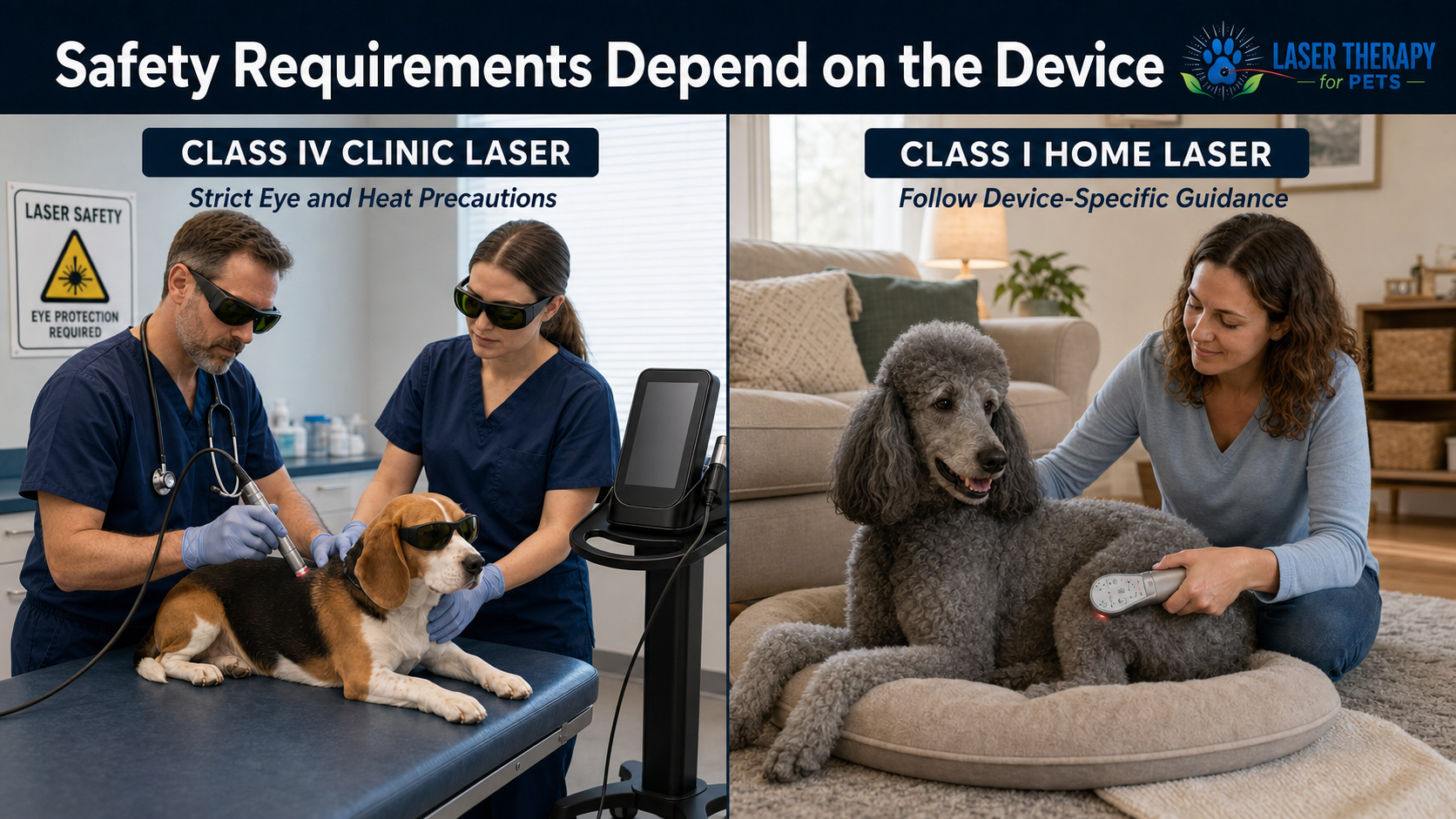
A Class IV beam can injure the eyes through direct exposure or reflected light, so everyone in the room, including your dog, needs properly fitted, laser-specific eye protection throughout the full treatment. In my experience, I have found that dogs do not like wearing laser goggles.
This is one more reason I prefer lower-level home lasers for most dogs. Class I devices do not require special goggles during normal use due to their safer delivery of light.
The main safety rule with any low level laser or bright light is simple: we do not shine it directly into the eyes. Any bright light shining into the eyes can cause temporary or permanent vision changes.
Vet Clinic Visits vs At-Home Laser Therapy for Dogs
A Class IV treatment may only take a minute or two, but your dog’s appointment is much longer than that. Your dog still has to get up, walk to the car, climb or be lifted inside, brace during the drive, wait at the clinic, stand on unfamiliar flooring, and then make the same trip home.
For a painful dog, all of that matters. A dog with arthritis may become sore from being lifted. A dog with back pain may tighten every muscle during the car ride. A dog with a knee injury may struggle on slick floors. By the time the laser treatment begins, your dog may already be more painful and more guarded.
Repeated pain signals can also make the nervous system more sensitive. This is called wind-up pain and results in a more painful or sensitive pup because those signals keep firing. Using a low-level laser at home allows for daily sessions and better control of pain.
Better pain management, prevention of wind-up pain, and natural inflammation control may allow your dog to remain comfortable without high doses of pain medications.
At home, you can perform a low-level laser session on your dog while he rests on his favorite bed, couch, blanket, or nonslip rug. The session feels calm and familiar, more like gentle petting from the family than a medical procedure.
Consistency Changes the Value of Treatment
For most mild to moderate problems I start with home laser therapy once a day. I adjust that schedule based on your dog’s diagnosis, the device you are using, the tissue we are treating, the stage of healing, and how your dog responds.
Appointments at vet clinics are usually at most 2-3 times a week.
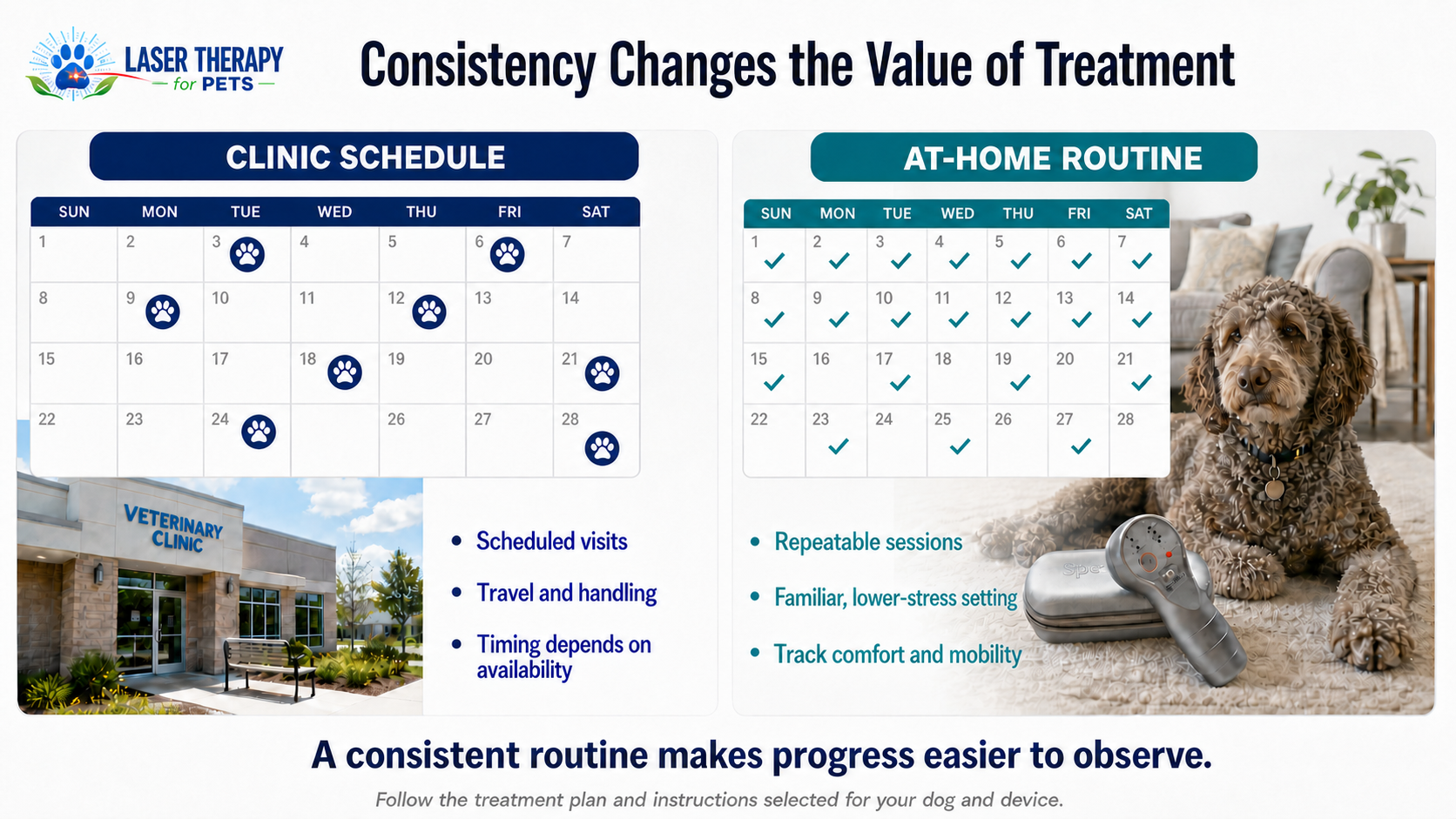
With laser therapy at home you can check the area each day and watch for changes in:
- Swelling or warmth
- Sensitivity to touch
- Ease of standing
- Comfort during the first few steps
- Willingness to walk or use stairs
- Sleep and nighttime restlessness
- Comfort after activity
Those daily observations and simple documentation give us a much clearer picture of whether the treatment plan is working. They are far more useful than trying to remember exactly how your dog was moving two weeks ago.
Dr. Candy’s Cold Laser Therapy Tracker
Record treatment dates, target areas, session length, comfort, mobility, and notes so you can spot patterns and follow your dog’s progress.
Clinic Class IV Visit vs At-Home Low-Level Laser Session
| Comparison Point | Class IV Laser Visit at the Vet Clinic | At-Home Low-Level Laser Session |
| Actual laser time | Often only 1 to 2 minutes | Often about 5 to 15 minutes |
| Total time commitment | Much longer than the treatment itself | Usually just the treatment session |
| Effect on a painful dog | Travel, lifting, waiting, and unfamiliar flooring can increase soreness and tension before treatment even starts | Treatment can begin while your dog is already calm and comfortable |
| Stress level | Higher for many dogs because of travel, handling, waiting room, barking, strange smells, bright lights, and the clinic environment | Lower for many dogs because the home session feels calm and familiar |
| Wind-up pain risk | Repeated pain signals may make a dog more sensitive and guarded | Daily home treatment may help improve pain control and reduce repeated pain buildup |
| Treatment frequency | Often limited by appointment scheduling, such as a few times per week | Easier to do daily when needed |
| Best timing | Depends on appointment availability | Can be done when your dog needs it most, including right before bedtime |
Key takeaway: For all of these reasons, I prefer low-level laser therapy at home for dogs. Your dog can receive a safer 5-15 minute treatment in a calm, familiar place, every day, without the added pain and stress of travel, lifting, slick clinic floors, protective goggles, or high-powered equipment.
That consistency improves pain control, reduces inflammation, supports tissue repair, and allows you to monitor your dog’s progress closely. In my experience, a safe, high-quality home laser is the most practical and effective way to use laser therapy for your dog.
How I Choose a Home Laser for Your Dog
Choosing a laser involves more than comparing one or two numbers. It depends on your individual dog and the condition you are targeting. In my in-depth guide, I walk you through wavelengths, output, pulsing, treatment area, heat, safety, treatment instructions, warranty, and support so you can compare devices with confidence.
I Separate Real Evidence From Marketing
Words such as “medical grade,” “high power,” and “Class IV” do not prove that one laser will produce better results for your dog. A long list of treatable conditions does not prove it either. Since laser devices for animals are not regulated by the FDA, a cheap laser sales page can make impressive claims without proving that the device delivers the therapeutic capabilities your dog needs.
Why I Prefer At-Home Low-Level Lasers for Most Dogs
A Class IV laser delivers a large amount of energy very quickly, but that high class number is a safety warning, not proof that it will help your dog heal better.
For most dogs who can be treated safely at home, I prefer a high-quality low-level cold laser. We are working toward the same photobiomodulation response, but with safer light delivery and without adding a car ride, waiting room, painful handling, or unfamiliar surroundings. You can also repeat the treatment more consistently, which is one of the biggest advantages of home care.
The quality of the home laser still matters. I look for the right wavelengths, clear output information, practical treatment times, safe operation, and instructions that match the tissue we are trying to treat.
After more than 14 years of using lasers in veterinary clinics and at home, I do not choose a device because it has the highest class or power number. I choose the safest device that can deliver the right light to the right tissue often enough to support your dog’s healing.
With a high-quality low-level laser, proper administration, and a consistent home routine, you can give your dog safe support using the natural power of light without leaving the comfort of home. Those simple sessions can help your dog move more freely, rest more comfortably, and get back to enjoying the little things that make him happy.
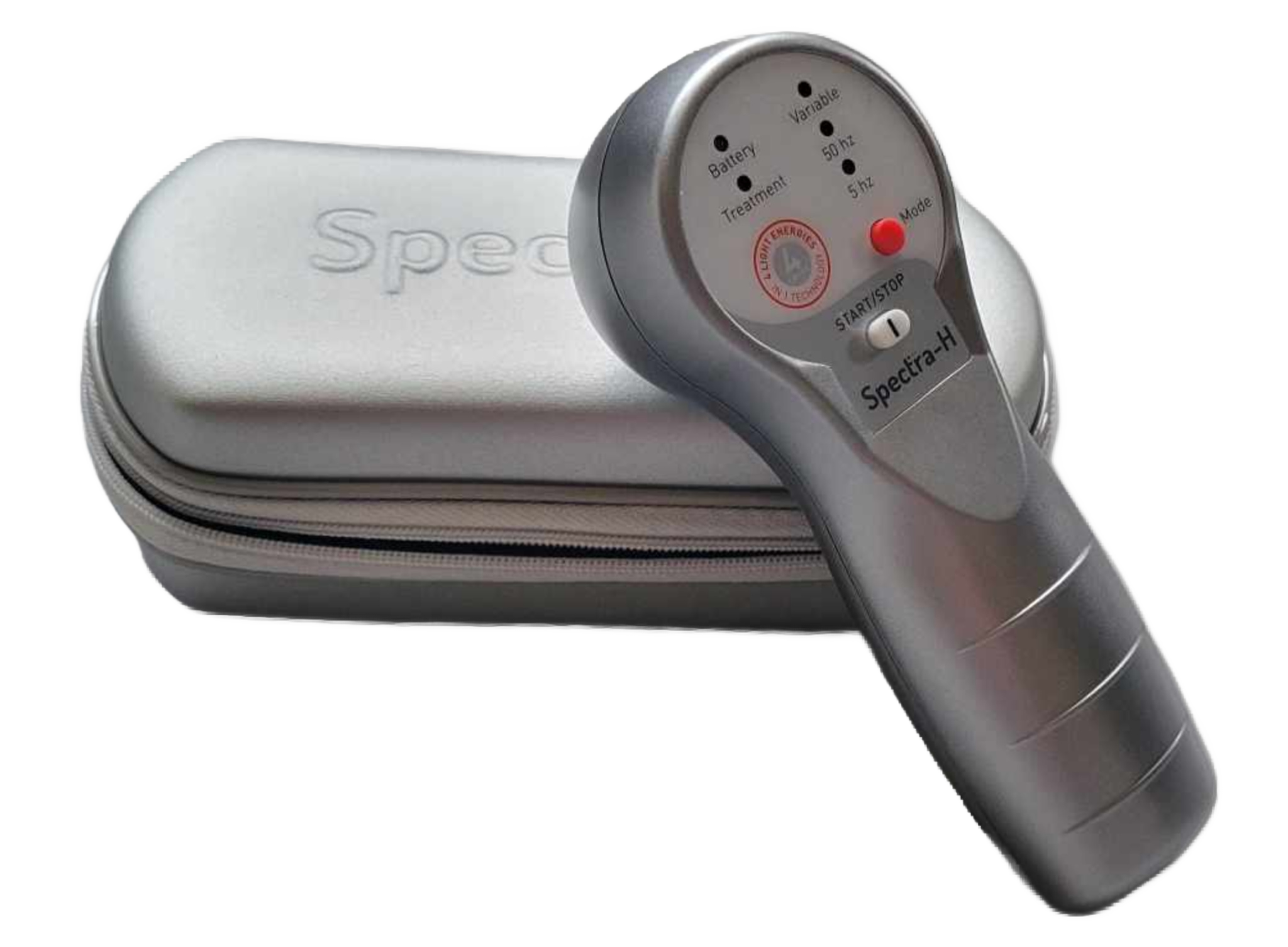 Dr. Candy’s recommended at-home laser
Meet the Spectra H
See why Dr. Candy recommends this multi-wavelength, low-level laser for practical, consistent therapy at home.
Dr. Candy’s recommended at-home laser
Meet the Spectra H
See why Dr. Candy recommends this multi-wavelength, low-level laser for practical, consistent therapy at home.
Frequently Asked Questions
Yes, a properly designed home low-level laser can deliver useful light to deeper targets when it includes suitable near-infrared or infrared wavelengths and adequate output. Wavelength, treatment area, and treatment time all affect delivery. The class number alone does not determine tissue penetration depth.
A Class IV clinic treatment for one area often takes about 1.5 to 2 minutes. A home low-level laser session often takes 5 to 15 minutes. The exact time depends on the device, target area, and protocol.
I do not recommend routine Class IV laser use by pet parents at home. It requires professional training, complicated settings, controlled operation, eye protection, and strict safety measures. A device specifically classified, labeled, and designed for home use is the safer choice.
Not every low-level laser requires goggles. Class I home devices do not require special eyewear during normal intended use, while Class IV devices have stricter requirements. Follow your manual for the exact device, keep the dog’s face turned away, and never direct the light toward the eyes.
Yes. A suitable home program can reduce trips made only for laser treatment because the family can complete planned sessions at home. It does not remove the need for diagnosis, medical reassessment, rehabilitation, or appointments for a new or changing problem.
References
- International Electrotechnical Commission. (2014). IEC 60825-1:2014 safety of laser products, Part 1: Equipment classification and requirements (3rd ed.).
- Millis, D. L., & Bergh, A. (2023). A systematic literature review of complementary and alternative veterinary medicine: Laser therapy. Animals, 13(4), 667. https://doi.org/10.3390/ani13040667
- Huang, Y.-Y., Chen, A. C.-H., Carroll, J. D., & Hamblin, M. R. (2009). Biphasic dose response in low level light therapy. Dose-Response, 7(4), 358–383. https://doi.org/10.2203/dose-response.09-027.Hamblin